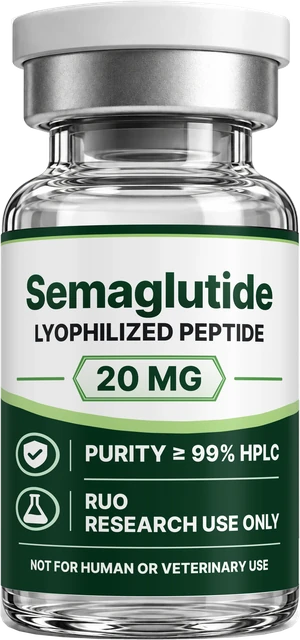
Semaglutide
GLP-1 receptor agonist
Related Laboratory Supplies
Essential items for laboratory research and sample preparation.


Third-Party Tested
HPLC Purity & Mass Spec Identity
Batch-Specific COA
Certificate for Each Batch
Discreet Packaging
Plain, Unbranded & Tamper-Evident
Same-Day Dispatch
Order Before 2PM AEST, Australia-Wide
Semaglutide is a synthetic peptide that acts as a glucagon-like peptide-1 (GLP-1) receptor agonist. It is studied for its effects on metabolic signalling, glucose regulation and receptor-mediated cellular responses. Semaglutide Australia research includes investigations into incretin pathways and metabolic function using controlled experimental models.
The Semaglutide material described on this page is intended strictly for laboratory and in-vitro research. It is not supplied for human or veterinary use.
What Is Semaglutide?
Semaglutide is a modified peptide based on the structure of human GLP-1, a naturally occurring incretin hormone involved in metabolic regulation.
It binds to and activates the GLP-1 receptor, a G protein-coupled receptor involved in glucose-dependent insulin signalling and other metabolic processes.
Semaglutide contains structural modifications that increase its resistance to enzymatic breakdown and extend its activity compared with native GLP-1.
The active pharmaceutical ingredient is used in registered medicines, including Ozempic and Wegovy. However, independently supplied Semaglutide research material is separate from these approved pharmaceutical products. It should not be considered therapeutically equivalent or suitable for clinical use.
Semaglutide in Metabolic Research
Semaglutide has been investigated in laboratory, preclinical and clinical research involving several aspects of metabolic function.
Research areas include:
- Glucose-dependent cellular signalling
- GLP-1 receptor activation and downstream pathways
- Incretin-related metabolic regulation
- Pancreatic beta-cell signalling
- Receptor interactions in experimental metabolic models
Laboratory studies may examine receptor binding, cAMP production and other measurable cellular responses.
Published clinical studies provide information about pharmaceutical Semaglutide under controlled medical conditions. Those findings do not establish the safety, effectiveness or suitability of independently supplied research material.
Quick Product Information
| Specification | Details |
|---|---|
| Product name | Semaglutide |
| Research classification | Synthetic GLP-1 receptor agonist |
| Research target | GLP-1 receptor (GLP-1R) |
| Molecular formula | C₁₈₇H₂₉₁N₄₅O₅₉ |
| Molecular weight | Approximately 4,113.58 g/mol |
| CAS number | 910463-68-2 |
| Physical form | Lyophilised powder, subject to product specification |
| Available strengths | 5mg, 10mg and 20mg |
| Purity | Refer to verified batch-specific CoA |
| Analytical testing methods | HPLC and MS/LC-MS, where documented |
| Certificate of Analysis | Batch-specific documentation, where available |
| Storage requirements | Follow verified batch-specific storage instructions |
| Intended use | Laboratory and in-vitro research only |
How Semaglutide Works in Research
GLP-1 Receptor Activity
Semaglutide interacts with GLP-1 receptors found in several tissues involved in metabolic regulation.
GLP-1 receptor activation stimulates intracellular signalling pathways, particularly those involving cyclic adenosine monophosphate (cAMP).
In suitable experimental models, these pathways can influence glucose-dependent insulin secretion, cellular responses and metabolic signalling.
Researchers examine these interactions to understand how GLP-1 receptor activation affects different biological systems.
Receptor Signalling and Molecular Stability
Native GLP-1 is rapidly degraded by enzymes, including dipeptidyl peptidase-4 (DPP-4).
Semaglutide has structural modifications that reduce enzymatic degradation and promote albumin binding, extending its activity.
These characteristics make it useful for investigating sustained GLP-1 receptor signalling under defined experimental conditions.
Semaglutide vs Other Incretin Research Peptides
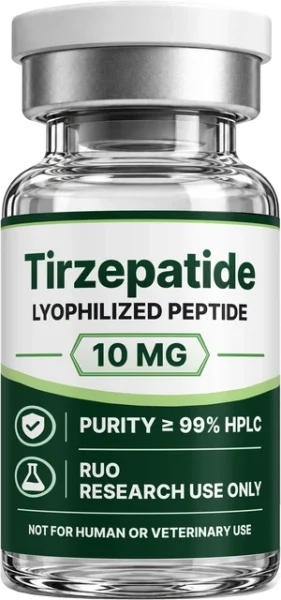
Semaglutide, Tirzepatide and Retatrutide are investigated for their interactions with receptors involved in metabolic regulation.
| Compound | Receptor activity |
|---|---|
| Semaglutide | GLP-1 |
| Tirzepatide | GIP + GLP-1 |
| Retatrutide | GIP + GLP-1 + Glucagon |
Semaglutide targets the GLP-1 receptor, while Tirzepatide activates two incretin receptors. Retatrutide also includes glucagon receptor activity.
These differences are relevant when selecting receptor pathways for experimental investigation.
Semaglutide Research in Australia
Semaglutide is an established pharmaceutical ingredient, with certain Semaglutide medicines registered by Australia’s Therapeutic Goods Administration (TGA).
This regulatory status does not extend automatically to independently supplied laboratory research peptides.
Australian researchers should consider applicable TGA requirements, institutional procedures and relevant laboratory regulations when handling research compounds.
Clear product identification, batch traceability and supporting analytical documentation are important for research records.
A research-only designation does not itself establish regulatory exemption or authorise human use.
Specifications
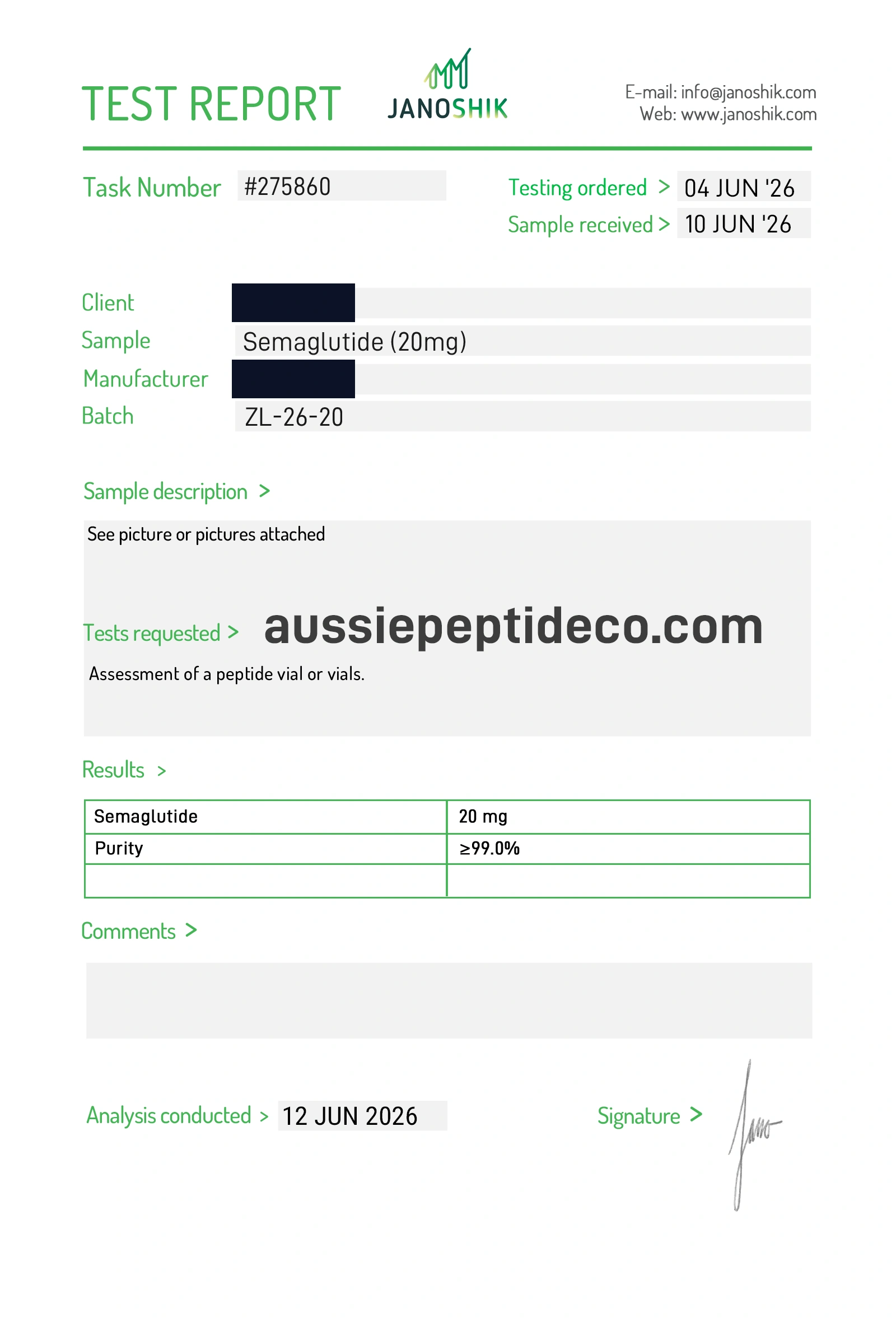
Certificate of Analysis
Quality, Purity and Batch Testing
Analytical testing helps researchers assess the identity and composition of Semaglutide material.
High-Performance Liquid Chromatography (HPLC) can be used to assess chromatographic purity and detect certain impurities.
Mass Spectrometry (MS), including LC-MS, can help confirm molecular mass and support compound identification.
A batch-specific Certificate of Analysis (CoA) should identify the material, batch number, testing methods and reported results.
Purity values should only be stated when supported by actual testing documentation.
Analytical purity does not confirm sterility, absence of endotoxins, clinical safety or suitability for administration.

Storage & Handling
Storage and Laboratory Handling
Semaglutide research material should be stored according to the verified conditions provided in its batch documentation.
Laboratories should manage temperature exposure, moisture, light and vial integrity where these factors may affect sample stability.
Appropriate contamination controls and laboratory standard operating procedures should be followed.
Storage duration and conditions after reconstitution should not be assumed without supporting stability data.
Research Use Only: For Research Use Only. Not for human or veterinary use. This material is intended strictly for laboratory and in-vitro research purposes and must not be consumed or administered.
Reconstitution calculator: Semaglutide 20mg
Work out concentration and the volume to draw for each aliquot before you add diluent.
- Concentration
- –
- Volume per aliquot
- –
- On a 1 mL (U-100) syringe
- –
- Aliquots per vial
- –
A laboratory arithmetic aid only. Verify every calculation independently. Not dosing guidance; research use only.
Semaglutide Frequently Asked Questions
Semaglutide is a synthetic GLP-1 analogue investigated for its effects on incretin signalling and metabolic regulation. It activates GLP-1 receptors involved in glucose-dependent cellular responses.
Semaglutide is a modified, long-acting GLP-1 receptor agonist. Its molecular structure includes amino acid substitutions and a fatty acid modification that influence enzymatic stability and albumin binding.
Semaglutide primarily targets the GLP-1 receptor. Activation of this receptor triggers intracellular signalling pathways involved in metabolic regulation, including cAMP-mediated responses in suitable experimental systems.
Semaglutide acts on GLP-1 receptors, whereas Tirzepatide activates both GIP and GLP-1 receptors. This distinction allows researchers to investigate different incretin signalling mechanisms.
Semaglutide is a single-receptor agonist. Retatrutide activates GLP-1, GIP and glucagon receptors, making its receptor activity broader and relevant to different experimental research questions.
Researchers investigate Semaglutide to understand GLP-1 receptor signalling, glucose-dependent cellular responses and metabolic pathway regulation. Studies include receptor-based assays, cellular models and preclinical experiments.
Semaglutide has the molecular formula C₁₈₇H₂₉₁N₄₅O₅₉ and a molecular weight of approximately 4,113.58 g/mol. Its CAS registry number is 910463-68-2.
HPLC can assess chromatographic purity and identify certain impurities. Mass spectrometry supports molecular identity verification. Results should be evaluated against the analytical methods documented for each batch.
A CoA should identify the compound, batch number, analytical methods, test results and relevant specifications. Supporting chromatograms or mass spectra may also be included where available.
No. This material is designated exclusively for laboratory and in-vitro research. It is not an approved medicine and must not be consumed, administered or used for human or veterinary treatment.
No. This product is supplied strictly for in-vitro laboratory research. It is not approved for human or veterinary use and must not be consumed or administered.
Orders placed before 2PM AEST on business days are dispatched the same day from Melbourne. Standard Post takes 3–7 business days and Express Post 1–3 business days, both tracked and discreet.
Reviews
There are no reviews yet.