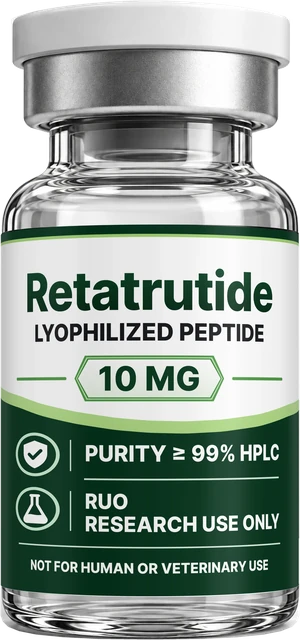
Retatrutide
Triple GLP-1 / GIP / Glucagon receptor agonist
Related Laboratory Supplies
Essential items for laboratory research and sample preparation.

Third-Party Tested
HPLC Purity & Mass Spec Identity
Batch-Specific COA
Certificate for Each Batch
Discreet Packaging
Plain, Unbranded & Tamper-Evident
Same-Day Dispatch
Order Before 2PM AEST, Australia-Wide
Retatrutide, also known as Reta or LY3437943, is an investigational peptide being studied for activity across three metabolic signalling pathways: GLP-1, GIP and glucagon receptors. This page provides technical information for laboratory and research contexts. Retatrutide remains investigational and should not be presented as an established treatment.
What Is Retatrutide?
Retatrutide (LY3437943) is an investigational peptide designed to activate three receptors involved in metabolic signalling: the glucose-dependent insulinotropic polypeptide receptor (GIPR), glucagon-like peptide-1 receptor (GLP-1R) and glucagon receptor (GCGR).
This triple-receptor profile is what makes Retatrutide scientifically distinct from compounds that primarily act on one or two of these pathways.
Researchers are studying how simultaneous receptor activity influences metabolic processes and how the pathways interact when activated by a single molecule. Published human trials have also investigated Retatrutide, but findings from clinical studies should not be interpreted as establishing the safety, efficacy or intended use of research material supplied separately for laboratory purposes.
Retatrutide remains under clinical investigation.
Quick Product Information
| Specification | Information |
|---|---|
| Product name | Retatrutide |
| Short name | Reta |
| Research classification | Triple receptor agonist |
| Research targets | GLP-1, GIP and glucagon receptors |
| Form | Lyophilised powder |
| Available strengths | 10mg, 20mg, 30mg, 40mg, 50mg |
| CAS number | 2381089-83-2 |
| Molecular formula | C₂₂₁H₃₄₂N₄₆O₆₈ |
| Molecular weight | 4,731.33 g/mol |
| Purity | ≥99% (HPLC) |
| Analytical testing | HPLC & LC-MS |
| Certificate of Analysis | Batch-specific CoA |
| Storage | Store at 2–8°C, protected from light and moisture. |
| Intended use | Laboratory research only |
How Retatrutide Works in Research
Retatrutide is generally described as a GIP, GLP-1 and glucagon receptor agonist. Each receptor provides a separate area of interest in metabolic research.
GLP-1 receptor activity
GLP-1 signalling has been widely studied in relation to glucose-dependent metabolic responses, gastrointestinal signalling, appetite-related pathways and energy balance.
GIP receptor activity
GIP is another incretin pathway involved in metabolic signalling. Research into GIP receptor agonism examines its relationship with insulin signalling, nutrient responses and interactions with other metabolic pathways.
Glucagon receptor activity
Glucagon signalling has a role in glucose regulation and energy metabolism. Its inclusion alongside GIP and GLP-1 activity makes Retatrutide useful for studying how three receptor systems may interact.
This combined activity distinguishes Retatrutide from single GLP-1 receptor agonists and dual GIP/GLP-1 receptor agonists.
Why Researchers Study Retatrutide
Research involving Retatrutide has examined several areas of metabolic biology. These include glucose-related signalling, lipid metabolism, energy expenditure, appetite-associated pathways, body composition and the broader effects of multi-receptor agonism.
A key research question is whether simultaneous activation of GLP-1, GIP and glucagon receptors produces biological responses that differ from targeting these pathways individually.
Clinical studies have evaluated measurable outcomes in human participants, including metabolic and body-weight-related endpoints. These findings relate to the investigational drug and conditions used in those trials. They should not be treated as evidence that independently supplied research material is safe, effective or appropriate for therapeutic use.
Retatrutide vs Other Incretin Research Compounds
The main scientific distinction can be understood through receptor activity:
| Compound | Principal receptor activity |
|---|---|
| Semaglutide | GLP-1 |
| Tirzepatide | GIP + GLP-1 |
| Retatrutide | GIP + GLP-1 + glucagon |
This comparison describes pharmacological targets rather than suggesting that one compound is preferable to another.
The additional glucagon receptor component of Retatrutide provides another pathway for researchers examining multi-receptor metabolic signalling.
Retatrutide Research in Australia
Researchers examining Retatrutide Australia material should pay particular attention to the identity and traceability of the individual batch.
Useful documentation may include a clearly identified batch number, analytical report, testing date, laboratory details and a Certificate of Analysis that can be matched directly to the material being examined.
Identity and purity are separate analytical questions. A stated purity percentage alone does not confirm molecular identity, sterility or suitability for a particular experimental purpose.
Researchers should therefore assess the complete documentation supplied with a batch rather than relying on a headline purity figure.
Australian regulatory requirements also need careful consideration. Retatrutide is currently an investigational compound and has not been approved by the TGA for therapeutic use.
Specifications
Certificate of Analysis
Quality, Purity and Batch Testing
Analytical testing provides researchers with information about the material associated with a particular batch.
HPLC is commonly used to examine chromatographic purity. It can identify the relative proportion of the target material compared with detectable impurities under the conditions of the analysis.
Mass spectrometry or LC-MS provides different information. It can support molecular identity by assessing mass-related characteristics of the analysed material.
A Certificate of Analysis (CoA) should connect these results with an identifiable batch rather than acting as a generic example.
Batch Information
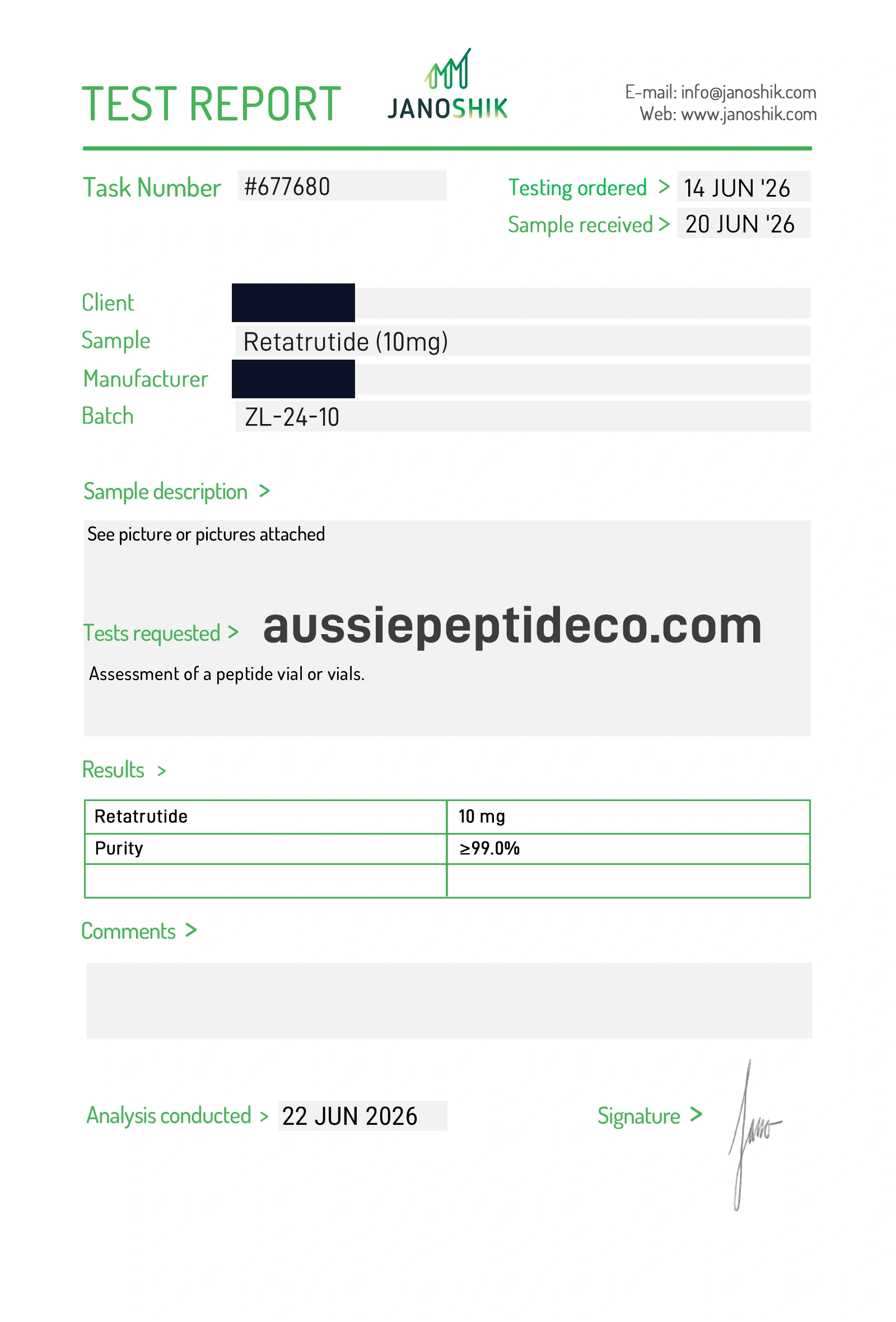
Batch Number: ZL-24-10
Testing Laboratory: Janoshik
Test Date: 22-June-2026
HPLC Result: ≥99% purity
Mass Spectrometry/LC-MS: Identity confirmed by LC-MS
CoA: Batch-specific Certificate of Analysis (CoA) available
Analytical purity should not be interpreted as evidence of clinical safety, efficacy, sterility or suitability for human use. Endotoxin, heavy-metal, bioburden or other results should only be stated where those tests were actually completed for the relevant batch.
Certificate of Analysis
A batch-specific CoA helps connect analytical results with the physical material supplied to a laboratory.
Researchers should check the batch identifier, testing date, analytical method, reported identity and purity data, and the identity of the testing laboratory or report issuer.
Where a downloadable CoA is provided, its batch number should correspond with the batch shown on the product documentation. A sample or historical CoA should not be treated as evidence for a different batch.

Storage & Handling
Storage and Laboratory Handling
Storage requirements should follow the conditions stated in the product’s verified technical documentation and any batch-specific information supplied with the material.
Laboratories should consider temperature control, moisture exposure, protection from light where applicable and preservation of vial integrity. Repeated or unnecessary temperature changes should be avoided where they conflict with validated storage procedures.
Laboratory personnel should follow their established SOPs for handling research peptides.
No unsupported stability period should be assumed after a material has been prepared or otherwise altered.
Reconstitution calculator: Retatrutide 10mg
Work out concentration and the volume to draw for each aliquot before you add diluent.
- Concentration
- –
- Volume per aliquot
- –
- On a 1 mL (U-100) syringe
- –
- Aliquots per vial
- –
A laboratory arithmetic aid only. Verify every calculation independently. Not dosing guidance; research use only.
Retatrutide Frequently Asked Questions
Retatrutide is an investigational peptide that acts as an agonist at GIP, GLP-1 and glucagon receptors. It is being studied in metabolic research and clinical trials.
“Reta” is a commonly used shortened name for Retatrutide. In research discussions, terms such as Reta peptide or Reta generally refer to Retatrutide, an investigational peptide studied for its activity at GLP-1, GIP and glucagon receptors.
Retatrutide has agonist activity at the GIP, GLP-1 and glucagon receptors, giving it a triple-receptor pharmacological profile.
Tirzepatide acts primarily at GIP and GLP-1 receptors, while Retatrutide adds glucagon receptor agonism to these two pathways.
HPLC can provide information on chromatographic purity and mass spectrometry or LC-MS can support molecular identity. Researchers should check the methods and results of that particular batch.
Yes. Retatrutide is provided with a batch specific Certificate of Analysis (CoA). The CoA can be matched to the supplied batch and contains relevant analytical information such as the batch number, HPLC purity result and LC-MS identity testing.
Respect storage conditions indicated in the product specific and batch documentation and in the laboratory SOPs that apply.
No. The material described here is intended strictly for laboratory and research purposes and is not intended for human or veterinary use.
No. This product is supplied strictly for in-vitro laboratory research. It is not approved for human or veterinary use and must not be consumed or administered.
Orders placed before 2PM AEST on business days are dispatched the same day from Melbourne. Standard Post takes 3–7 business days and Express Post 1–3 business days, both tracked and discreet.

Reviews
There are no reviews yet.