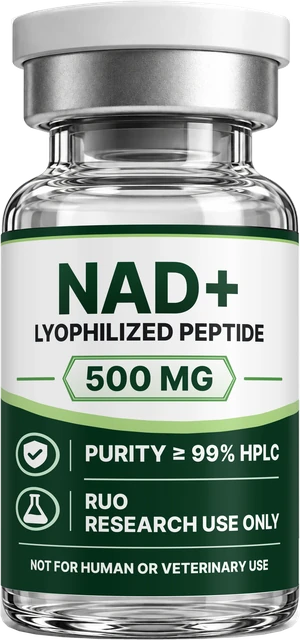
NAD+
Nicotinamide Adenine Dinucleotide (oxidised)
Related Laboratory Supplies
Essential items for laboratory research and sample preparation.
Third-Party Tested
HPLC Purity & Mass Spec Identity
Batch-Specific COA
Certificate for Each Batch
Discreet Packaging
Plain, Unbranded & Tamper-Evident
Same-Day Dispatch
Order Before 2PM AEST, Australia-Wide
NAD+ (nicotinamide adenine dinucleotide) is a naturally occurring coenzyme involved in cellular energy metabolism and biochemical signalling. It plays a central role in oxidation-reduction reactions and supports the activity of enzymes associated with cellular maintenance.
NAD+ Australia research focuses on its role in mitochondrial function, metabolic regulation and cellular responses to stress. The NAD+ material described here is intended strictly for laboratory and in-vitro research, not for human or veterinary use.
What Is NAD+?
NAD+ stands for nicotinamide adenine dinucleotide, an essential coenzyme found in living cells. Unlike a peptide, NAD+ is a dinucleotide composed of two nucleotides joined through their phosphate groups.
It exists primarily in two forms: oxidised NAD+ and reduced NADH. These forms participate in electron-transfer reactions that are important for normal cellular metabolism.
NAD+ also acts as a substrate for enzymes such as sirtuins, poly (ADP-ribose) polymerases (PARPs) and CD38. These enzymes are studied for their involvement in cellular signalling, DNA damage responses and NAD+ metabolism.
Laboratory researchers investigate NAD+ to understand how its availability influences biochemical pathways under different experimental conditions.
NAD+ in Cellular and Metabolic Research
NAD+ laboratory research covers several established areas of biochemistry.
Researchers investigate NAD+ availability in cellular energy metabolism, mitochondrial function, oxidative stress responses and enzyme-dependent signalling pathways.
Experimental studies also examine NAD+ biosynthesis and recycling through the salvage pathway, including the roles of nicotinamide phosphoribosyltransferase (NAMPT) and nicotinamide mononucleotide adenylyltransferases (NMNATs).
Changes in NAD+ metabolism have been observed in ageing-related and metabolic research models. However, findings from cell cultures or animal studies cannot automatically be applied to humans.
The results depend on the experimental model, material characteristics and study conditions.
Quick Product Information
| Specification | Details |
|---|---|
| Product name | NAD+ (Nicotinamide Adenine Dinucleotide) |
| Research classification | Dinucleotide coenzyme |
| Research targets | Redox reactions, NAD+-dependent enzymes and cellular metabolism |
| Molecular formula | C₂₁H₂₇N₇O₁₄P₂ (free acid) |
| Molecular weight | 663.43 g/mol (free acid) |
| CAS number | 53-84-9 (free acid) |
| Physical form | Confirm against supplied batch documentation |
| Available strengths | 500 mg and 1000 mg |
| Purity | Refer to verified batch-specific CoA |
| Analytical testing methods | HPLC and MS/LC-MS, where documented |
| Certificate of Analysis | Batch-specific CoA, where available |
| Storage requirements | Follow product-specific storage documentation |
| Intended use | Laboratory and in-vitro research only |
Note: The molecular formula, molecular weight and CAS number refer to the free-acid form of NAD+. Specifications may differ for NAD+ salts or other supplied forms. The material’s chemical identity should be confirmed against its batch documentation.
How NAD+ Works in Research
NAD+ and Cellular Energy Metabolism
NAD+ functions as an electron acceptor in metabolic reactions. During these processes, NAD+ is reduced to NADH, which carries electrons involved in cellular energy production.
Researchers examine this relationship in glycolysis, the tricarboxylic acid cycle and mitochondrial oxidative phosphorylation. The balance between NAD+ and NADH provides information about cellular redox conditions.
NAD+-Dependent Enzyme Activity
NAD+ also serves as a substrate for several enzyme families, including sirtuins, PARPs and CD38.
These enzymes participate in protein modification, DNA damage responses and NAD+ turnover. Their activity can influence intracellular NAD+ availability.
Studying both functions helps researchers understand the relationship between energy metabolism and cellular signalling.
NAD+ vs Other Metabolic Research Compounds
NAD+ is often discussed alongside compounds involved in NAD+ biosynthesis and recycling.
| Compound | Biochemical role |
|---|---|
| NAD+ | Coenzyme involved in redox reactions and enzyme signalling |
| NADH | Reduced form of NAD+, involved in electron transfer |
| NMN | Intermediate in NAD+ biosynthesis |
| NR | NAD+ precursor converted through cellular metabolic pathways |
These compounds have different biochemical functions. They should not be treated as interchangeable research materials.
NAD+ Research in Australia
Australian laboratories working with NAD+ should maintain suitable documentation for material identification, batch traceability and experimental records.
Researchers should confirm the chemical form, supplied quantity and analytical information before incorporating material into laboratory protocols.
The Therapeutic Goods Administration (TGA) regulates therapeutic goods in Australia. Independently supplied research-only NAD+ material must not be represented as a TGA-approved medicine or as suitable for therapeutic administration.
Applicable regulatory obligations depend on the product’s intended purpose, presentation and relevant Australian requirements.
Research-only labelling does not independently establish regulatory compliance.
Specifications
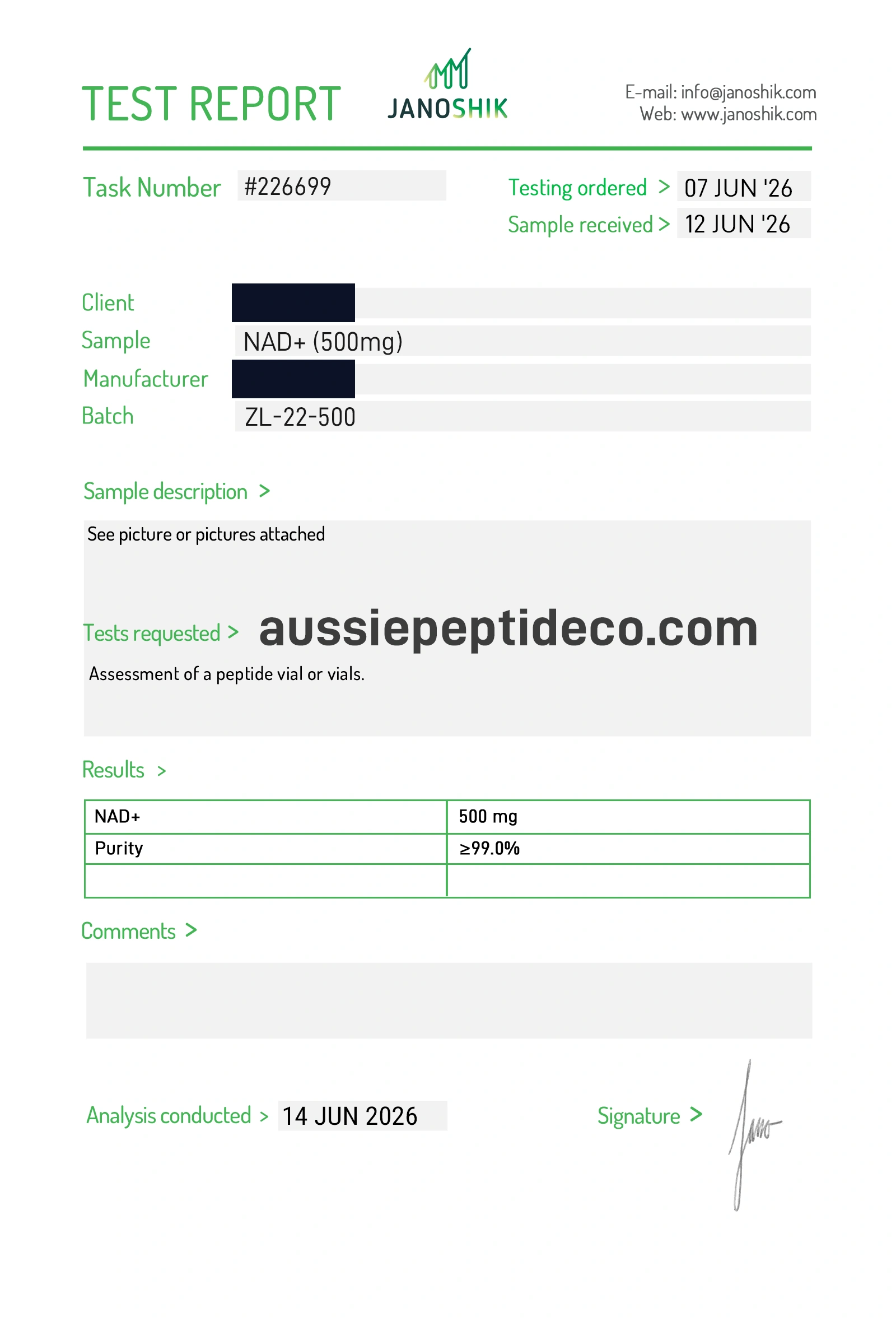
Certificate of Analysis
Quality, Purity and Batch Testing
Analytical testing helps laboratories assess the identity and composition of NAD+ research material.
High-Performance Liquid Chromatography (HPLC) can separate NAD+ from detectable impurities and related compounds. Mass spectrometry (MS) can provide supporting molecular identity information.
A batch-specific Certificate of Analysis (CoA) should identify the material, batch reference, testing methods and reported results.
Testing information must correspond to the actual supplied batch. A stated purity percentage should not be used without supporting analytical documentation.
Chemical purity does not establish sterility, endotoxin status, safety or suitability for human administration.

Storage & Handling
Storage and Laboratory Handling
NAD+ storage conditions depend on its chemical form, formulation and available stability information.
Laboratories should follow the supplied product documentation for temperature requirements and any necessary protection from moisture or light.
Vials should be checked for packaging integrity and clearly identified during storage.
Standard laboratory procedures should address contamination prevention, sample tracking and handling.
No fixed expiry period or stability after preparation should be assumed without supporting product-specific data.
Research Use Only: For Research Use Only. Not for human or veterinary use. This material is intended strictly for laboratory and in-vitro research purposes and must not be consumed or administered.
Reconstitution calculator: NAD+ 500mg
Work out concentration and the volume to draw for each aliquot before you add diluent.
- Concentration
- –
- Volume per aliquot
- –
- On a 1 mL (U-100) syringe
- –
- Aliquots per vial
- –
A laboratory arithmetic aid only. Verify every calculation independently. Not dosing guidance; research use only.
NAD+ Frequently Asked Questions
NAD+ is a naturally occurring coenzyme involved in cellular metabolism. It supports electron-transfer reactions and acts as a substrate for enzymes associated with cellular signalling and maintenance.
No. NAD+ is a dinucleotide coenzyme, not a peptide. Its structure contains nucleotide components rather than the amino acid chains that define peptides.
NAD+ is the oxidised form, while NADH is the reduced form. Both participate in electron-transfer reactions that support cellular energy metabolism.
NAD+ participates in metabolic reactions that generate NADH. Researchers study this relationship to understand mitochondrial respiration, electron transport and cellular energy regulation.
NMN is an intermediate used in NAD+ biosynthesis. NAD+ itself functions as a coenzyme and enzyme substrate in numerous cellular biochemical processes.
The molecular formula of NAD+ in its commonly referenced free-acid form is C₂₁H₂₇N₇O₁₄P₂, with a molecular weight of approximately 663.43 g/mol.
Researchers investigate changes in NAD+ metabolism during cellular ageing, particularly its relationship with mitochondrial activity, DNA damage responses and NAD+-dependent enzymes. These findings remain dependent on experimental conditions.
HPLC can assess chromatographic purity by separating detectable components. Mass spectrometry may support molecular identity verification. Results should be documented for the specific material batch.
A CoA should identify the compound, batch number, analytical methods, test results and relevant specifications. Additional information may include testing dates and laboratory identification.
No. This material is supplied exclusively for laboratory and in-vitro research. It is not intended for consumption, injection, therapeutic administration or veterinary applications.
No. This product is supplied strictly for in-vitro laboratory research. It is not approved for human or veterinary use and must not be consumed or administered.
Orders placed before 2PM AEST on business days are dispatched the same day from Melbourne. Standard Post takes 3–7 business days and Express Post 1–3 business days, both tracked and discreet.
Reviews
There are no reviews yet.