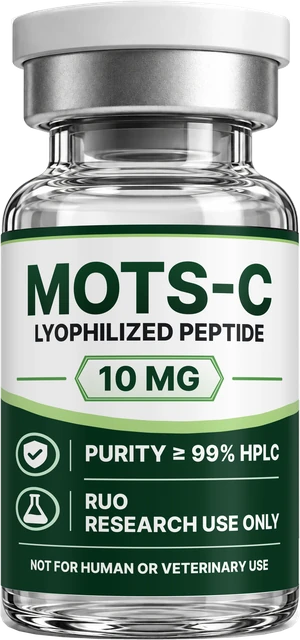
MOTS-c
Mitochondrial-derived peptide (16 aa)
Related Laboratory Supplies
Essential items for laboratory research and sample preparation.


Third-Party Tested
HPLC Purity & Mass Spec Identity
Batch-Specific COA
Certificate for Each Batch
Discreet Packaging
Plain, Unbranded & Tamper-Evident
Same-Day Dispatch
Order Before 2PM AEST, Australia-Wide
MOTS-c is a mitochondrial-derived peptide studied for its involvement in cellular metabolism, energy regulation and responses to metabolic stress. Research into MOTS-c focuses on how mitochondrial signalling interacts with cellular pathways involved in glucose metabolism and energy balance.
MOTS-c Australia research material is intended strictly for laboratory and in-vitro investigations. It is not a pharmaceutical product and is not intended for human or veterinary use.
What Is MOTS-c?
MOTS-c (Mitochondrial Open Reading Frame of the 12S rRNA-c) is a naturally occurring peptide consisting of 16 amino acids. It is encoded within the mitochondrial 12S ribosomal RNA region of mitochondrial DNA.
Unlike many peptides encoded by nuclear DNA, MOTS-c belongs to a group of mitochondrial-derived peptides associated with communication between mitochondria and other cellular systems.
Published studies have investigated its relationship with metabolic regulation, cellular stress responses and AMP-activated protein kinase (AMPK) signalling.
The MOTS-c research peptide described here is independently supplied laboratory material. Findings involving naturally occurring MOTS-c or experimental models should not be interpreted as evidence of therapeutic effects or suitability for human administration.
MOTS-c in Metabolic Research
MOTS-c laboratory research covers several aspects of cellular metabolism and mitochondrial signalling.
Published investigations have examined:
- Glucose-related metabolic pathways and cellular energy regulation.
- AMPK-associated signalling in experimental systems.
- Mitochondrial communication with nuclear regulatory pathways.
- Cellular responses to metabolic and oxidative stress.
- Metabolic adaptation in cell-based and animal research models.
Early studies have reported changes in metabolic markers under particular experimental conditions. These findings require interpretation within the methods and limitations of each study.
Results from animal models or cell cultures cannot automatically be applied to humans or independently supplied research material.
Quick Product Information
| Specification | Details |
|---|---|
| Product Name | MOTS-c |
| Research Classification | Mitochondrial-derived peptide |
| Research Targets | AMPK-associated signalling, cellular metabolism and metabolic stress pathways |
| Amino Acid Sequence | MRWQEMGYIFYPRKLR |
| Molecular Formula | C₁₀₁H₁₅₂N₂₈O₂₂S₂ |
| Molecular Weight | Approximately 2,174.6 g/mol |
| CAS Number | 1627580-64-6 |
| Physical Form | Lyophilised peptide powder, subject to product documentation |
| Available Strengths | 10 mg and 20 mg |
| Purity | Refer to the verified batch-specific CoA |
| Analytical Testing Methods | HPLC and MS/LC-MS, where documented |
| Certificate of Analysis | Batch-specific documentation should be consulted |
| Storage Requirements | Follow verified product-specific storage instructions |
| Intended Use | Laboratory and in-vitro research only |
How MOTS-c Works in Research
AMPK Signalling
AMP-activated protein kinase (AMPK) is a cellular energy sensor involved in coordinating metabolic responses when energy availability changes.
Experimental studies have linked MOTS-c activity with AMPK-associated signalling. This has encouraged research into its possible involvement in cellular energy regulation and metabolic adaptation.
However, the precise relationship between MOTS-c and AMPK can depend on the experimental model and conditions.
Mitochondrial and Cellular Stress Signalling
Mitochondria participate in energy production and also contribute to cellular signalling.
Research has examined whether MOTS-c influences cellular responses to metabolic stress, including changes in gene regulation and metabolic pathway activity.
Some experimental findings suggest that MOTS-c may participate in communication between mitochondria and the nucleus.
These mechanisms remain areas of ongoing investigation rather than established therapeutic applications.
MOTS-c vs Other Metabolic Research Peptides
MOTS-c differs from incretin-related peptides in its biological origin and investigated signalling pathways.
| Compound | Primary Research Focus |
|---|---|
| MOTS-c | Mitochondrial-derived signalling and AMPK-associated metabolic pathways |
| Semaglutide | GLP-1 receptor agonism |
| Tirzepatide | Dual GIP and GLP-1 receptor agonism |
| Retatrutide | GIP, GLP-1 and glucagon receptor agonism |
MOTS-c is not classified as an incretin receptor agonist. Its research centres on mitochondrial signalling and metabolic regulation rather than direct activation of GIP or GLP-1 receptors.
MOTS-c Research in Australia
Researchers working with MOTS-c in Australia should consider material identity, batch traceability, analytical documentation and the regulatory status of the intended research activity.
The Therapeutic Goods Administration (TGA) regulates therapeutic goods supplied in Australia. Independently supplied MOTS-c research material should not be represented as a TGA-approved medicine.
Laboratories should maintain appropriate records of material identification, supplier documentation and experimental handling procedures.
Research-only labelling does not automatically remove applicable regulatory obligations. Researchers should assess relevant Australian requirements before importing, handling or using the material.
Specifications
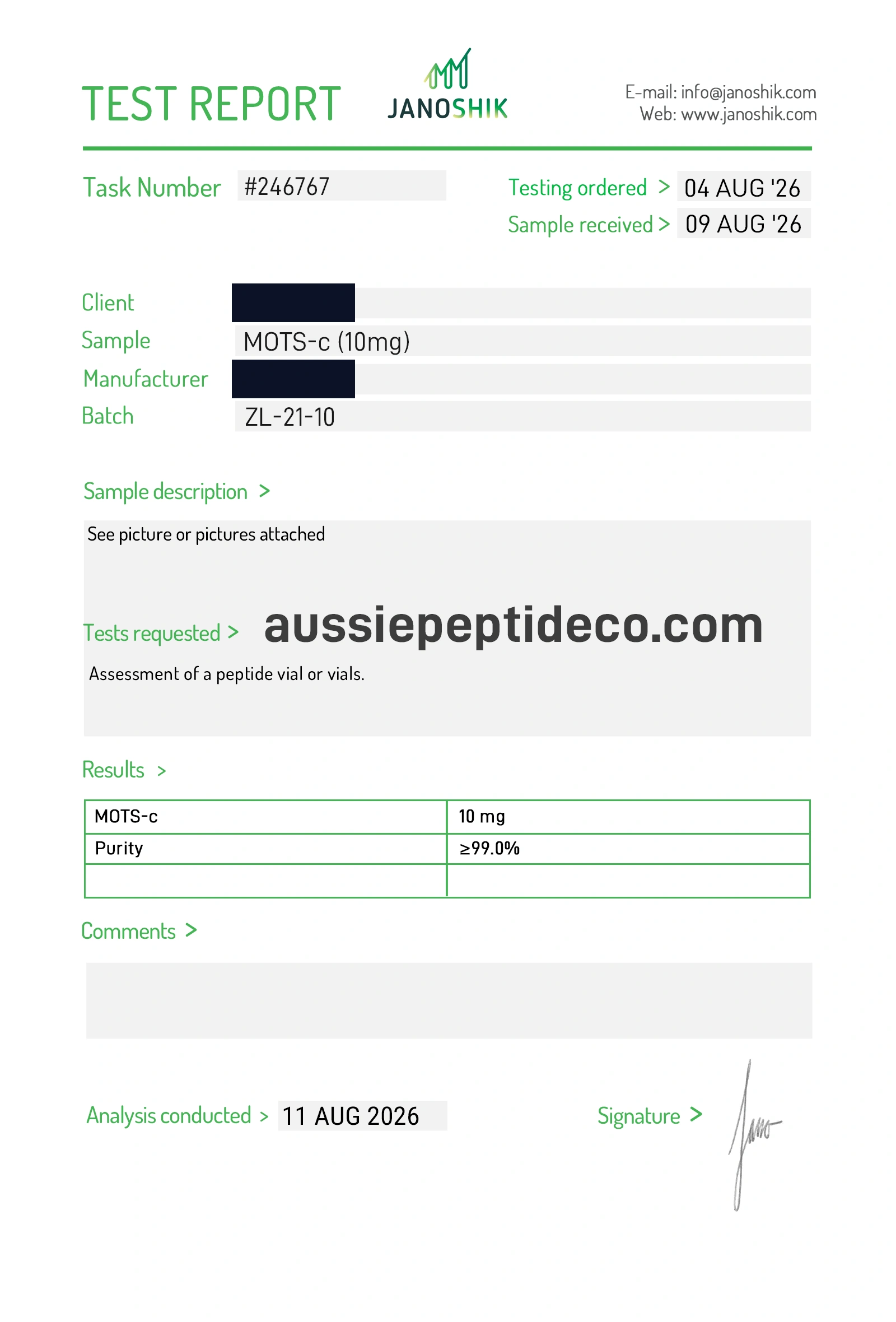
Certificate of Analysis
Quality, Purity and Batch Testing
Analytical testing helps laboratories assess the identity and composition of peptide research materials.
High-Performance Liquid Chromatography (HPLC) can be used to assess chromatographic purity and identify detectable impurities under a specified method.
Mass Spectrometry (MS or LC-MS) provides molecular mass information that supports peptide identity assessment.
A batch-specific Certificate of Analysis (CoA) should identify the tested material, batch reference, analytical methods, results and relevant acceptance criteria.
Purity percentages should only be published when supported by actual test documentation.
Analytical purity does not establish sterility, biological safety or suitability for human or veterinary administration.

Storage & Handling
Storage and Laboratory Handling
MOTS-c research material should be stored according to the conditions specified in its verified product or batch documentation.
Laboratories should consider temperature control, moisture exposure, light sensitivity where relevant and the integrity of sealed containers.
Appropriate contamination controls and sample identification procedures should be followed during handling.
Storage periods and stability following reconstitution should not be assumed without supporting experimental data. Laboratory standard operating procedures should take precedence over generalised peptide storage recommendations.
Research Use Disclaimer: For Research Use Only. Not for human or veterinary use. This material is intended strictly for laboratory and in-vitro research purposes and must not be consumed or administered.
Reconstitution calculator: MOTS-c 10mg
Work out concentration and the volume to draw for each aliquot before you add diluent.
- Concentration
- –
- Volume per aliquot
- –
- On a 1 mL (U-100) syringe
- –
- Aliquots per vial
- –
A laboratory arithmetic aid only. Verify every calculation independently. Not dosing guidance; research use only.
MOTS-c Frequently Asked Questions
MOTS-c is a 16-amino-acid mitochondrial-derived peptide encoded within mitochondrial DNA. Researchers study its involvement in cellular energy regulation, metabolic signalling and responses to physiological stress.
MOTS-c belongs to the mitochondrial-derived peptide family. Unlike conventional nuclear-encoded peptides, its amino acid sequence originates from a small open reading frame within mitochondrial DNA.
Published research associates MOTS-c with AMPK signalling, folate metabolism, purine biosynthesis and cellular stress responses. The extent of these interactions varies across experimental models.
Semaglutide acts as a GLP-1 receptor agonist. MOTS-c is a mitochondrial-derived peptide investigated for its relationship with cellular metabolism and energy-sensitive signalling pathways.
Retatrutide activates GIP, GLP-1 and glucagon receptors. MOTS-c has a different biological origin and is investigated primarily in mitochondrial signalling and metabolic adaptation research.
Researchers investigate MOTS-c because experimental studies suggest links with cellular energy sensing, glucose-related pathways and metabolic stress responses, particularly in preclinical models.
The molecular formula of the unmodified MOTS-c peptide is C₁₀₁H₁₅₂N₂₈O₂₂S₂, with an approximate molecular weight of 2,174.6 g/mol. Salt forms may have different specifications.
HPLC can assess chromatographic purity, while mass spectrometry supports molecular identity verification. Results should be interpreted using the analytical method and documentation for the specific batch.
A CoA should identify the peptide, batch number, analytical methods, measured results, acceptance criteria and testing details, allowing laboratories to review material identity and traceability.
No. This independently supplied MOTS-c material is intended exclusively for laboratory and in-vitro research. It is not approved or supplied for human or veterinary administration.
No. This product is supplied strictly for in-vitro laboratory research. It is not approved for human or veterinary use and must not be consumed or administered.
Orders placed before 2PM AEST on business days are dispatched the same day from Melbourne. Standard Post takes 3–7 business days and Express Post 1–3 business days, both tracked and discreet.

Reviews
There are no reviews yet.