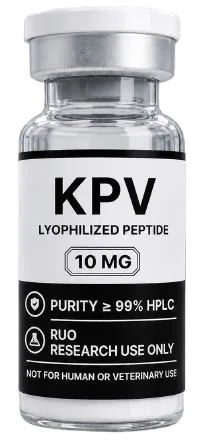
KPV 10mg
alpha-MSH C-terminal tripeptide
≥99.0%
Third-Party
COA
Complete your research kit
Also searched as: KPV tripeptide, alpha-MSH 11-13
Third-Party Tested
HPLC & mass spec verified purity
Batch Specific COA
Certificate with every batch
Discreet Packaging
Plain, unbranded, tamper-evident
Same-Day Dispatch
Before 2PM AEST, Australia-wide
KPV is a short research peptide consisting of three amino acids: lysine, proline and valine. It represents the C-terminal tripeptide sequence of alpha-melanocyte-stimulating hormone (α-MSH), a peptide associated with melanocortin signalling. KPV peptide is studied primarily in experimental models involving inflammatory signalling, cellular responses and barrier biology. Supplied as a lyophilised research material, it is intended exclusively for controlled laboratory investigation and analytical work.
What Is KPV?
KPV, also written as Lys-Pro-Val, is a tripeptide derived from the terminal region of α-MSH. Although considerably smaller than the parent peptide, KPV has attracted research interest because experimental studies suggest it may retain some biological activities associated with α-MSH without reproducing all of its receptor-mediated effects.
Research has particularly examined KPV in relation to inflammatory signalling. Preclinical and cellular studies have explored its interactions with pathways involved in inflammatory mediator production and cellular responses to inflammatory stimuli.
Its small molecular structure also makes KPV useful for investigating how short peptide sequences may influence biological processes independently of the complete α-MSH molecule.
Key Research Areas
Current KPV research is concentrated mainly on:
Much of the available evidence comes from laboratory, cell-based and animal research. These findings should therefore be interpreted as experimental observations rather than established therapeutic effects in humans.
Why Researchers Study KPV
KPV is scientifically interesting because it provides a relatively simple peptide model for investigating selected biological activities associated with α-MSH.
Experimental studies have examined whether KPV can influence inflammatory signalling without requiring the complete α-MSH peptide. Research has also investigated mechanisms involving NF-κB activity and the expression of certain inflammatory mediators.
Another area of interest is epithelial and intestinal research. Experimental models have explored KPV transport across cellular barriers and its potential interactions with peptide transport systems.
These characteristics make KPV relevant to laboratories studying peptide signalling, inflammation-related pathways and cellular barrier mechanisms.
Key Research Areas at a Glance
KPV in Australia
Researchers looking for KPV Australia suppliers should review product specifications, batch documentation and analytical testing before ordering. Information such as current KPV price, stock status, vial quantity, testing method and domestic Australian shipping should be confirmed directly from the current product listing.
When comparing KPV peptide Australia products, batch-specific CoA documentation can provide useful analytical information for laboratory procurement decisions.
Specifications
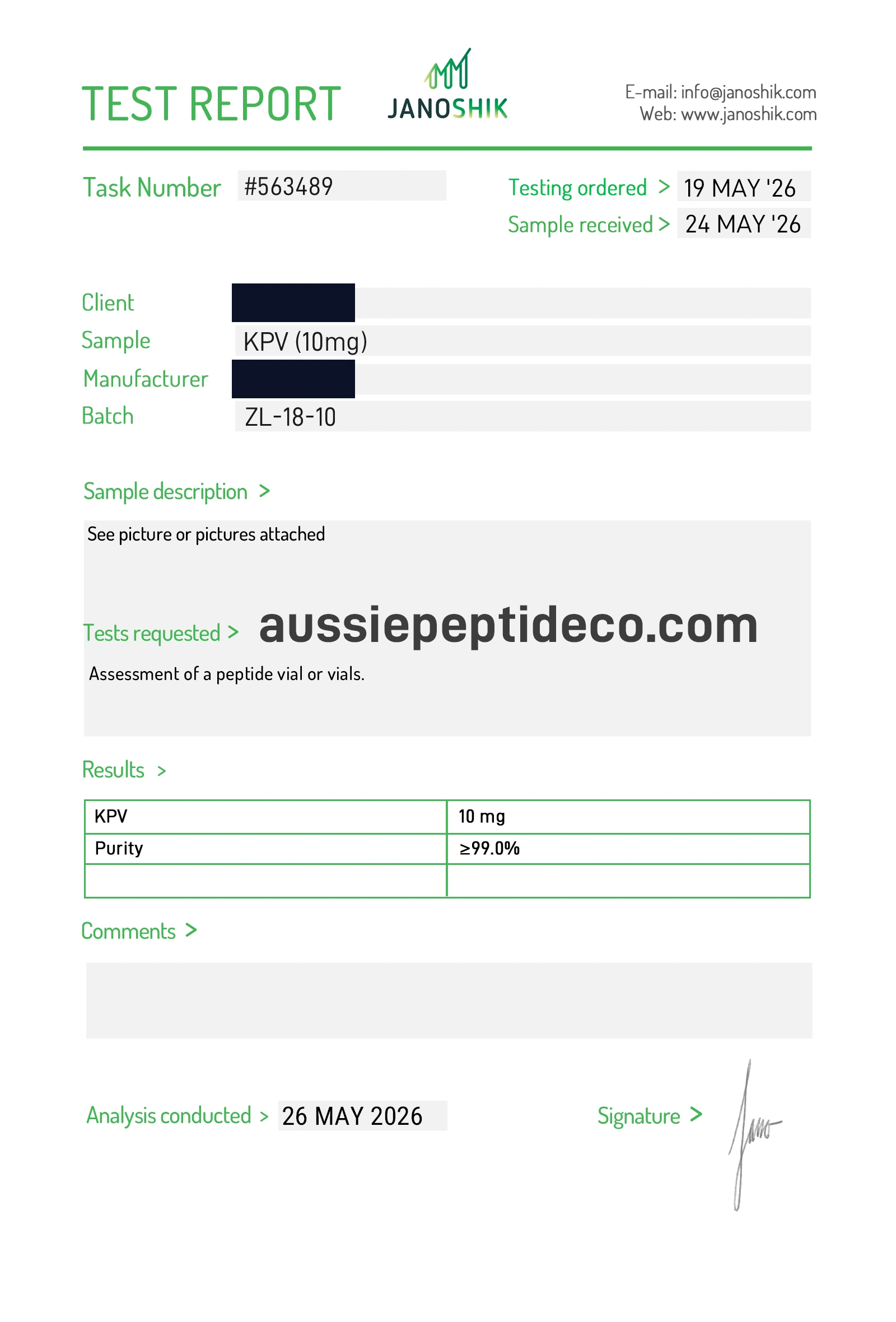
Certificate of Analysis
Quality, Purity and Batch Testing
KPV should be evaluated as a laboratory material using appropriate analytical documentation. Product specifications may include the nominal peptide quantity, stated purity and analytical methods such as high-performance liquid chromatography (HPLC) and mass spectrometry or LC-MS.
Where batch-specific testing is available, researchers should consult the corresponding Certificate of Analysis (CoA) for information relating to identity, purity and analytical results.
Analytical purity confirms characteristics of the tested material; it does not establish clinical safety or therapeutic effectiveness.

Storage & Handling
Storage and Laboratory Handling
- Lyophilised storage: Follow the storage conditions stated on the product label, batch documentation or supplier specification.
- After reconstitution: Where validated post-reconstitution stability information is unavailable, laboratories should follow their established protocol and relevant batch documentation.
Avoid assuming a specific shelf life, solvent, concentration or stability period unless supported by verified product data.
Reconstitution calculator: KPV 10mg
Work out concentration and the volume to draw for each aliquot before you add diluent.
- Concentration
- –
- Volume per aliquot
- –
- On a 1 mL (U-100) syringe
- –
- Aliquots per vial
- –
A laboratory arithmetic aid only. Verify every calculation independently. Not dosing guidance; research use only.
KPV 10mg: Frequently Asked Questions
KPV is the tripeptide Lys-Pro-Val, corresponding to the C-terminal sequence of α-MSH and studied primarily in experimental inflammatory and cellular models.
Studies have investigated KPV in connection with inflammatory signalling, including pathways associated with NF-κB and inflammatory mediator expression.
KPV forms the final three-amino-acid sequence of α-MSH and is investigated to understand whether this short sequence retains selected biological activities.
Research areas include inflammatory signalling, epithelial biology, intestinal models, cellular transport and immune-related pathways.
Purity and testing depend on the individual batch. Researchers should check the product specification and relevant analytical report.
Where provided, a batch-specific CoA may document peptide identity, purity and results from methods such as HPLC or LC-MS.
Follow verified supplier and batch-specific storage instructions. Post-reconstitution conditions should not be assumed without validated information.
KPV may be sourced from Australian research-peptide suppliers where available. Researchers should verify current stock, price, testing documentation and shipping details before ordering.
No. This product is supplied strictly for in-vitro laboratory research. It is not approved for human or veterinary use and must not be consumed or administered.
Orders placed before 2PM AEST on business days are dispatched the same day from Melbourne. Standard Post takes 3–7 business days and Express Post 1–3 business days, both tracked and discreet.

Reviews
There are no reviews yet.